

To find the Bill Gates essay on AI, start with the original on Gates Notes and check its title and date. Two relevant pieces are The Age of AI has begun, dated March 21, 2023, and The turbulent AI era is here. The choices we make now are critical., dated August 26, 2026.
This guide helps you choose the right source and write a short, attributed response. Use the essay itself for its complete argument. The worksheet and editorial examples below are original teaching material; they show how to read, summarize and evaluate a source rather than reproduce it.
Identify which essay your task refers to
Open the official source rather than relying on a screenshot of a headline. Record the author, displayed publication date, exact title and URL in your reading notes. If a teacher or colleague shared a passage, match that passage to the original before deciding which essay they mean.
The 2023 piece introduces opportunities and risks across areas such as work, health and education. The 2026 piece gives more attention to preparing for the transition and to choices about how benefits and harms are distributed. Read each argument in its own date context instead of treating the two articles as one interchangeable statement.
Scroll to see all columns
| If your task mentions… | Start with… | Check before writing |
|---|---|---|
| A March 2023 AI essay | The 2023 Gates Notes source | The exact passage and its surrounding section |
| An August 2026 argument about transition choices | The 2026 Gates Notes source | The author’s claim, condition and proposed response |
| A repost with no date | The original link or a matching passage | Whether the repost combines different sources |
A publication date establishes when a statement was made. It does not by itself establish that a prediction has come true. If your response evaluates current conditions, gather separate current evidence for that evaluation.
Make a three-column reading note
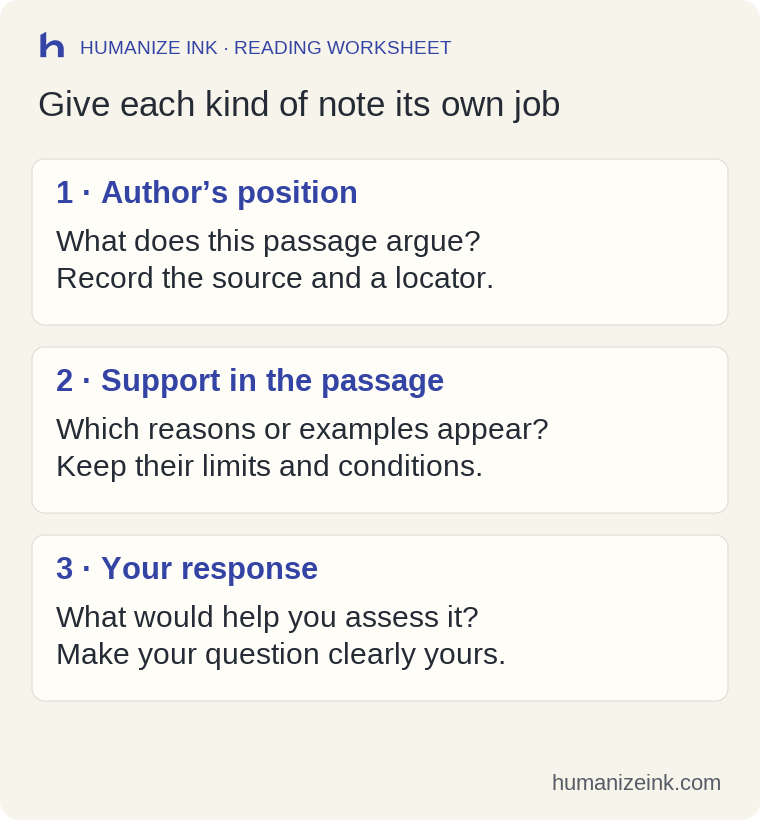
Create three headings in your own document: what the author says, what supports it, and what I think. Use a short note for each main passage. Put a section heading or paragraph locator beside the note so you can find the passage again.
The first column is for a fair account of the author’s position. The second records the examples, reasoning or sources the passage actually supplies. The third is for your question or judgment. Keeping those jobs separate makes it easier to write a response with clear ownership of each claim.
For example, a reader’s question might be: “What evidence would show that a proposed transition measure helps the group it is meant to help?” That is your evaluation question. It should not be presented as if the essay itself had supplied the answer.
Mark the kind of claim
Label a note as an observation, prediction, value judgment or recommendation. The labels are practical reading aids. They help you select a reporting verb: describes, expects, argues or proposes. A prediction should retain its uncertainty when you paraphrase it.
Preserve conditions and scope
Look for a specified group, timeframe, comparison or condition. Keep it beside your note. If an argument depends on a future choice, a summary should carry that condition forward. A sentence that replaces a conditional outcome with a certainty changes the argument.
Draft a short attributed summary
Begin with the author and the central point you have identified. Then add the part of the argument your assignment needs. Select a small number of points rather than listing every topic in order. The complete essay remains the right source for the full discussion.
An original summary sentence for the 2026 piece is: “Gates argues that preparing for the AI transition should include choices about how its benefits and harms are distributed.” This is a concise paraphrase, not a quotation. Link or cite the original in the format your task requires.
Compare it with this deliberately overstated draft: “Gates proves that AI will benefit everybody.” The stronger verb and unconditional outcome go beyond what this summary needs. A responsible paraphrase can be clear and direct while keeping the author’s argument distinct from a proven result.
 Original manual example
Choose a reporting verb that fits
Overstated draft
Gates proves that AI will benefit everybody.
Manual summary
Gates argues that preparing for the AI transition should include choices about how benefits and harms are distributed.
- Argues attributes a position.
- Your evaluation needs its own evidence.
humanizeink.com
Add your own response after the summary
Once you have stated the argument fairly, choose one point to examine. Explain why it matters and what evidence would help you assess it. A useful response can agree with a goal while questioning a particular assumption or asking how a recommendation would be evaluated.
Use a structure such as: “The argument raises [specific question]. To assess that point, I would look for [kind of evidence] because [reason].” Fill the brackets with your own reading. This structure gives the response a job beyond repeating the source in different words.
Here is an original filled response: “Gates argues that choices during the AI transition affect how its benefits and harms are distributed. My question is how a proposed training programme would reach people with different access to time and technology. I would compare participation and completion across those groups before judging the programme’s reach.”
The first sentence attributes the source’s position. The hypothetical programme and evaluation question belong to this reader’s response; they show how to build a specific next question.
For a short class response, distinguish the source paragraph from your response paragraph. For a longer essay, use transitions and citations to make the change of voice clear. Follow your assignment’s rules for AI assistance and source acknowledgment.
Check quotations, paraphrases and the final wording
Copy a direct quotation exactly, use quotation marks and provide the required locator. For a paraphrase, close the source briefly and explain the point from your notes, then reopen it to verify the meaning. This tests your understanding more usefully than replacing individual words one by one.
Keep your reading notes separate from any language polish. If you use the English rewriting editor on your own response, share only an excerpt you are allowed to submit and compare the result with the original. Check that the edit keeps attribution and the difference between a claim, a prediction and your evaluation.
The word frequency counter can help you notice repeated written words in your draft. A repeated technical term may be necessary. Decide by reading the sentence rather than treating repetition as an automatic fault.
Frequently asked questions
Where can I read the original Bill Gates essay on AI?
Use the Gates Notes links near the start of this guide. Check the title and publication date against the essay mentioned in your task.
Which essay is this guide about?
It identifies the 2023 and 2026 sources, then demonstrates source-reading and attribution with a short summary of the 2026 argument.
Can I treat a prediction in the essay as a confirmed fact?
Report it as a prediction or argument with the relevant condition. Use separate evidence when evaluating whether it has happened.
How long should my summary be?
Follow the assignment or reader’s need. State the central point and the few supporting ideas needed for your response, with clear attribution.
How should I use a direct quotation?
Keep the wording exact, mark it as a quotation and supply the citation or locator required by your task.
How do I separate my response from Gates’s claim?
Attribute the summary with a reporting verb such as argues. Begin your evaluation with your own question, and identify the evidence you would use to assess it.