

Cowslip is a flower name. In British nature writing it commonly refers to Primula veris, a small yellow-flowered plant. The Royal Horticultural Society identifies it as common cowslip. In ordinary prose, write a cowslip for one plant and cowslips for several.
A reader may meet the word in a poem, a description of a meadow or a botanical caption. Start with that literal plant meaning. The surrounding scene can add mood or significance. This guide shows how to separate the named object from your interpretation and how to make a description useful to someone who has never seen the flower.
Picture the flower behind the word
The common cowslip has yellow flowers held above a low cluster of leaves. The RHS describes nodding, bell-shaped flowers gathered on upright stems. That gives a reader three useful visual cues: yellow, clustered, and nodding. You can use those cues to explain the word in a sentence without turning the paragraph into a plant catalogue.
Try this original sentence: “Cowslips nodded above the grass beside the gate.” The flower name identifies what is there; nodded gives the small flowers movement. For a general audience, “clusters of yellow cowslips” supplies more help than the name alone.
Use a botanical source when the identity matters. Common plant names vary by region, and a fictional scene may use them loosely. For precise identification, look for a scientific name and the place where the plant was observed.
Use cowslip and cowslips in a sentence
Cowslip is one word. As a common plant name, it normally starts with a lowercase letter inside a sentence. The plural adds s. Capitalization at the start of a sentence follows the usual rule.
Scroll to see all columns
| Form | Original sentence | What the form tells you |
|---|---|---|
| A cowslip | A cowslip grew beside the stone. | One plant |
| Cowslips | Cowslips dotted the bank. | More than one plant |
| Cowslip flowers | She sketched the cowslip flowers. | The flowers are the focus |
| Primula veris | The caption identifies the plant as Primula veris. | A scientific identification |
Choose the object you mean
“One cowslip” can mean one plant in everyday writing. If you mean an individual flower rather than a whole plant, write “one cowslip flower.” That distinction matters in a close observation: one stem may hold a cluster of flowers. A drawing caption should make clear which part the arrow or description identifies.
Keep the scientific name distinct
Write the genus with a capital and the species with lowercase: Primula veris. Italics distinguish the scientific name from surrounding prose. A garden sign, source quotation or published title may follow its own display conventions; copy that source accurately when quoting it.
Explain cowslip meaning in a poem or story
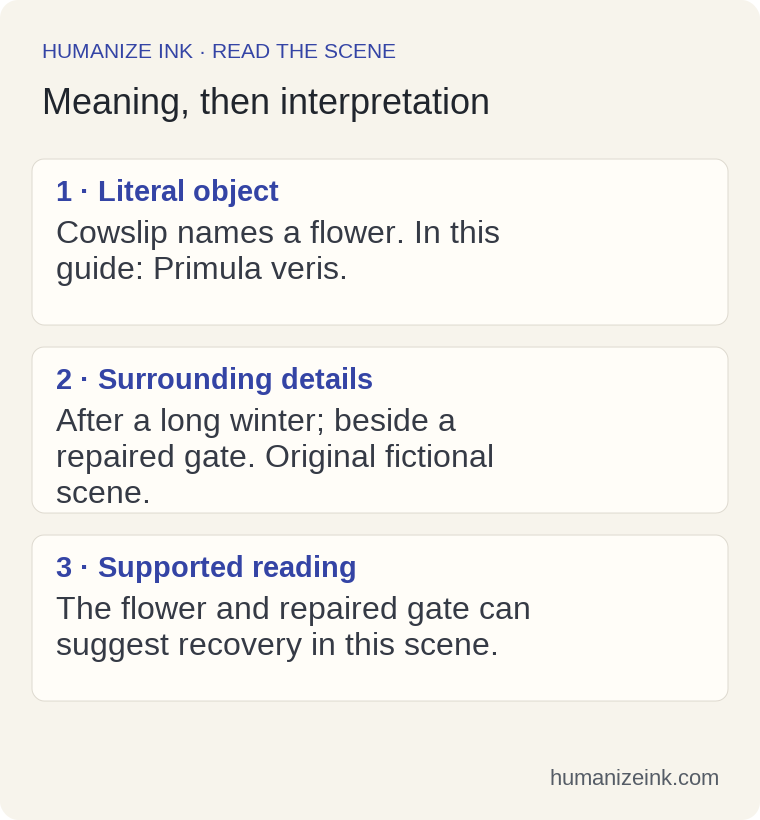
In literary reading, first identify the flower and its immediate setting. Then ask what the passage actually does with it. Does the narrator notice it after a difficult journey? Does it contrast with a ruined building? Is it part of a remembered place? Those details support an interpretation more firmly than a universal list of flower symbols.
An original fictional line might read: “After the long winter, Lena found cowslips beside the repaired gate.” A possible reading is that the flowers join the repaired gate in suggesting renewal. The argument rests on after the long winter and repaired, as well as on the plant. Present that as an interpretation of this invented scene.
A useful reading note has two parts: “Cowslip names the yellow flower; in this passage, its appearance beside the repaired gate supports a sense of recovery.” A different passage could support a different effect. Keep literal definition and contextual inference visible as two separate steps.
Revise a vague nature description
Start with what your reader should be able to picture. “There were beautiful flowers” communicates a reaction but leaves the object open. A more specific sentence can name the plant, its color, its position or its movement. Pick the details that matter to the scene.
Original draft: “There were beautiful flowers near the wall.”
Manual revision: “Yellow cowslips nodded above the grass at the foot of the wall.”
This is an original teaching example. The revision assumes the observer has identified the flowers as cowslips. If that identity is uncertain, an accurate alternative is “Small yellow flowers nodded above the grass.” Precision includes being clear about what you actually know.
 Original manual example
Give the reader a visible scene
Draft
There were beautiful flowers near the wall.
Manual revision
Yellow cowslips nodded above the grass at the foot of the wall.
- Plant identity must be confirmed.
- Color, movement and position give the image shape.
humanizeink.com
Use the word in your own editing
Read the sentence before and after the flower name. Add one visual cue when your audience needs it, and keep the rhythm of the paragraph. A travel note may need only “yellow cowslips.” A close observational paragraph may need the clustered flowers and low leaves. A poem may deliberately leave the image spare.
If a draft repeatedly uses flower, paste a short excerpt into the word frequency counter, inspect the count, then decide which repetitions help. The counter measures written word forms; it does not identify plants or decide which image is strongest. Keep a repeated word when it makes the sentence clearer.
For English sentence-level revision, use the rewriting editor with a short, shareable paragraph and compare its result with the original. Check that a change keeps the plant name, color and location. The final description should match the scene you intended to convey.
Frequently asked questions
What does cowslip mean in simple English?
It is a flower name. In British nature writing, common cowslip usually means Primula veris, a yellow-flowered plant.
Is cowslip one word or two?
One word: cowslip. Use cowslips for the ordinary plural.
Should cowslip have a capital letter?
Use lowercase in ordinary prose unless it begins a sentence or belongs to a title or proper name.
Does cowslip always symbolize the same thing?
Interpret its role through the passage. The setting, action and narrator determine whether the flower suggests renewal, memory or another effect.
How is cowslip different from Primula veris?
Cowslip is a common name; Primula veris is a scientific name for the plant discussed here. The scientific name helps specify identity when regional names differ.
What if I cannot identify the flower?
Describe the visible details you know, such as small yellow flowers in a cluster, and consult an appropriate botanical source before using a precise species name.