

A diphthong is a vowel sound that moves from one vowel quality toward another within one syllable. In many standard English descriptions, the vowel in day is written /eɪ/. The two symbols describe a glide inside that one syllable.
The British Council’s TeachingEnglish definition uses play and made as examples. To understand the term, focus on the sound first and the spelling second. This guide gives a small set of English examples, a listening routine and an original editing exercise for explaining pronunciation to another reader.
Listen for one continuous vowel movement
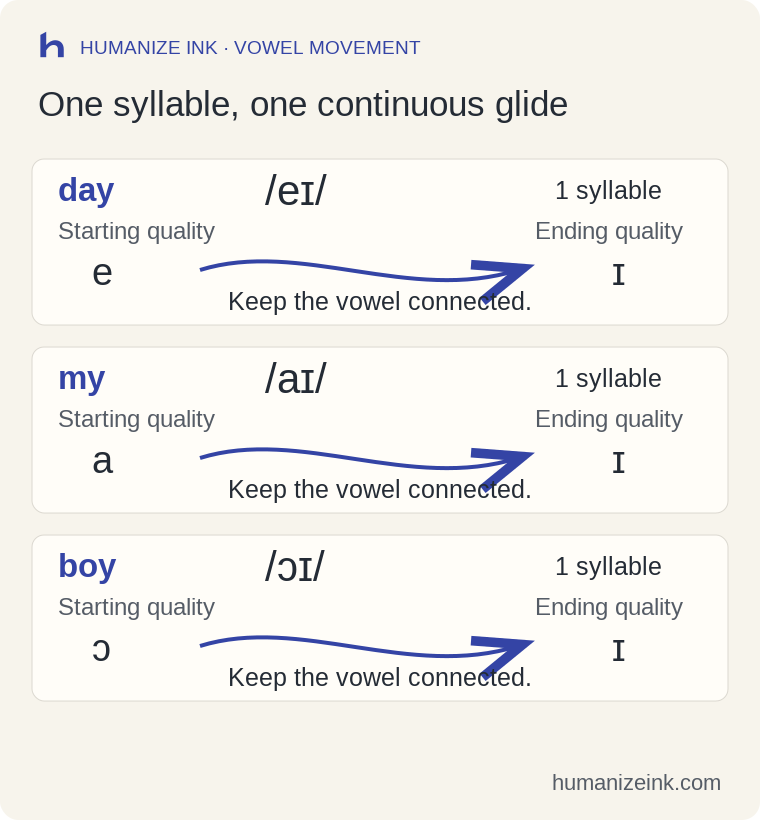
Say day slowly, keeping it as one syllable. Your mouth changes position while the vowel continues. A classroom transcription such as /eɪ/ represents that movement with two vowel symbols. It is one syllable, even though the transcription has more than one symbol.
Try the same idea with my /aɪ/, boy /ɔɪ/ and now /aʊ/. These are useful starting examples because the glide is easy to notice when you lengthen the vowel. Listen to a dictionary’s recording for your target accent, then repeat the whole word at normal speed.
A slow version is a way to notice the movement, not a goal for every conversation. The sound should stay connected. If your practice turns day into two separately stressed pieces, return to the recording and keep one syllable’s rhythm.
Separate sounds, letters and syllables
A diphthong describes pronunciation. Two written vowel letters do not automatically make a diphthong, and one written vowel can represent a diphthong. Compare rain and my: both can contain a vowel glide even though their spellings look quite different.
Scroll to see all columns
| Word | Common dictionary transcription | What to notice |
|---|---|---|
| day | /deɪ/ | One syllable; a glide |
| my | /maɪ/ | One written vowel letter can carry a glide |
| boy | /bɔɪ/ | The vowel moves toward /ɪ/ |
| now | /naʊ/ | The movement ends toward /ʊ/ |
For a written assignment, state which accent or dictionary you are following. Pronunciation varies. A spelling exercise, a phonemic transcription and a syllable-counting exercise may ask different questions about the same word.
Read the IPA as a sound description
The slashes in /deɪ/ mark a pronunciation transcription. The letters in day are its ordinary spelling. Keep those two systems visually distinct in a teaching note. That makes it easier for a learner to see whether you are discussing the written form or the spoken sound.
Keep a syllable separate from a letter count
Syllables are units of spoken rhythm. Count them by listening to the word, with a dictionary recording when needed. Counting vowel letters can produce the wrong answer. The word day has three letters and one syllable; the vowel glide is only part of its pronunciation.
Compare a diphthong with a steady vowel
A monophthong is described with one main vowel quality in a phonemic system. Introductory charts often contrast this with the moving quality of a diphthong. The categories are descriptions of a particular pronunciation system; actual speech can have finer detail.
Use a simple explanation for a beginner: “Listen for a change in vowel quality while the syllable stays together.” That instruction directs attention to an audible difference. It is more useful than asking the learner to search the spelling for any pair of vowel letters.
The British Council lists eight diphthongs for Received Pronunciation. Treat that as a statement about that pronunciation model, rather than a fixed count for every English accent. Other varieties can describe or realize the vowel system differently.
Practise with a small word set
Choose three words from the table: day, my, boy. Open a reliable dictionary’s pronunciation entry and listen to one word at a time. Repeat each word once slowly and once at a comfortable speaking pace. Keep the syllable continuous in both versions.
Write a short observation beside each: “I hear the vowel moving,” or “I split the word into two beats and need to reconnect it.” A note about your own attempt gives you a useful next action. It also keeps practice focused on one feature instead of trying to judge your entire accent.
For a classroom explanation, put the word, transcription and syllable count on separate lines. Ask the learner to point to the item being discussed. That small layout choice prevents the instruction “two vowels” from being confused with “two letters” or “two syllables.”
Edit an explanation so it teaches the right idea
Draft explanation: “A diphthong is two vowel letters together, so it has two syllables.”
Manual revision: “A diphthong is a vowel glide within one syllable. For example, the vowel in day is commonly written /eɪ/.”
This original teaching example corrects the definition and gives the reader something to hear. It keeps the explanation short enough to use beside a chart. If your audience already knows IPA, you can add detail about the starting and ending vowel qualities.
When revising a pronunciation handout in the English rewriting editor, keep the technical terms and IPA beside your original source. Compare the result carefully: a smoother sentence should preserve the distinction between letters, sounds and syllables. The editor changes English wording; dictionary recordings are the appropriate place to hear the example.
 Original manual example
Name the sound, then give an example
Draft
A diphthong is two vowel letters together, so it has two syllables.
Manual revision
A diphthong is a vowel glide within one syllable. In day, it is commonly written /eɪ/.
- Sound and spelling are distinct.
- One syllable can contain a moving vowel.
humanizeink.com
Frequently asked questions
What does diphthong mean in simple English?
A vowel sound that changes quality within one syllable. The vowel in day, often written /eɪ/, is a common example.
Does a diphthong have two syllables?
The glide occurs within one syllable. The two vowel symbols in a transcription describe movement rather than two separate syllables.
Are two vowel letters always a diphthong?
Spelling and sound are different systems. Listen to the word and check its pronunciation rather than counting written vowel letters.
How many diphthongs are there in English?
The British Council gives eight for Received Pronunciation. Counts and realizations depend on the accent and the transcription system.
How can I practise the sound?
Listen to a dictionary recording, repeat the whole word slowly with a continuous vowel, then return to normal speed.
Can the word frequency counter identify diphthongs?
The counter measures written Latin-letter words. Use a pronunciation dictionary or teacher for sound-level analysis.