

Dreck is an informal noun for material someone considers very poor quality. A reviewer might call a script dreck; a reader might use it for writing they find worthless or badly made. Cambridge Dictionary marks this quality sense as informal and uncountable.
The word tells you how strongly the speaker feels. To understand the criticism, look for the reasons around it. To write useful criticism yourself, connect the opinion with a specific feature and a revision. The original examples below show both an expressive use and a practical editing alternative.
Read dreck as a judgment about quality
“The brochure was dreck” gives a strong negative assessment. It leaves the reader to discover what failed: inaccurate information, awkward wording, poor organization or something else. In a conversation, that emotional force may be the point. In an analytical review, the next sentence should explain the assessment.
Compare these original sentences:
- A character’s opinion: “I spent the train ride reading that dreck.”
- A review with a reason: “The final chapter is dreck: it repeats the opening argument and gives the reader no new evidence.”
- An editorial observation: “The final chapter repeats the opening argument; replace the repeated summary with the missing evidence.”
The first establishes a voice. The second combines a blunt verdict with an explanation. The third makes the next action easiest to follow. Choose the version that fits what the reader is supposed to do.
Use the noun naturally in a sentence
For this ordinary quality sense, treat dreck as a mass noun: some dreck, a pile of dreck, or this dreck. Use singular agreement when the word is the subject: “This dreck is taking up space.”
Scroll to see all columns
| Useful pattern | Original example | What it emphasizes |
|---|---|---|
| This dreck | This dreck needs a complete rewrite. | A strong verdict on the material |
| A pile of dreck | He called the abandoned pages a pile of dreck. | A body of material, through his viewpoint |
| Dreck followed by a reason | The dialogue is dreck because every character sounds identical. | A verdict plus a specific criticism |
Name the material
If the reference is unclear, introduce the object first: the brochure, draft, dialogue or script. Then the reader knows what this points to. A sentence such as “She tossed the dreck aside” is vivid only after the scene gives the reader something to picture.
Locate the speaker’s opinion
In reporting, attribute a judgment to the person who made it: “The reviewer dismissed the script as dreck.” In your own review, support the verdict with examples and explain the standard you are using. This helps readers separate an individual reaction from an observable feature of the work.
Compare dreck, rubbish, clutter and weak writing
The best alternative depends on the problem you want to describe. A pile of papers can be clutter even when each page is useful. A weak introduction can contain accurate facts but present them in an ineffective order.
Scroll to see all columns
| Wording | Main job | When it helps |
|---|---|---|
| Dreck | Express a strong informal quality judgment | Dialogue, a deliberately blunt review |
| Rubbish or trash | Give a broad dismissive verdict | Informal speech, with regional usage in mind |
| Clutter | Identify material that crowds a space or message | A layout or organization problem |
| Repetitive writing | Name recurring information or phrasing | Feedback that needs a concrete revision |
| Unsupported claim | Identify a statement lacking evidence | Fact review or argument editing |
Read the nearby sentence before replacing one word with another. “Cut the clutter” asks for selection and organization. “Check the unsupported claim” asks for evidence. Naming the real problem makes a comment more useful than choosing a milder insult.
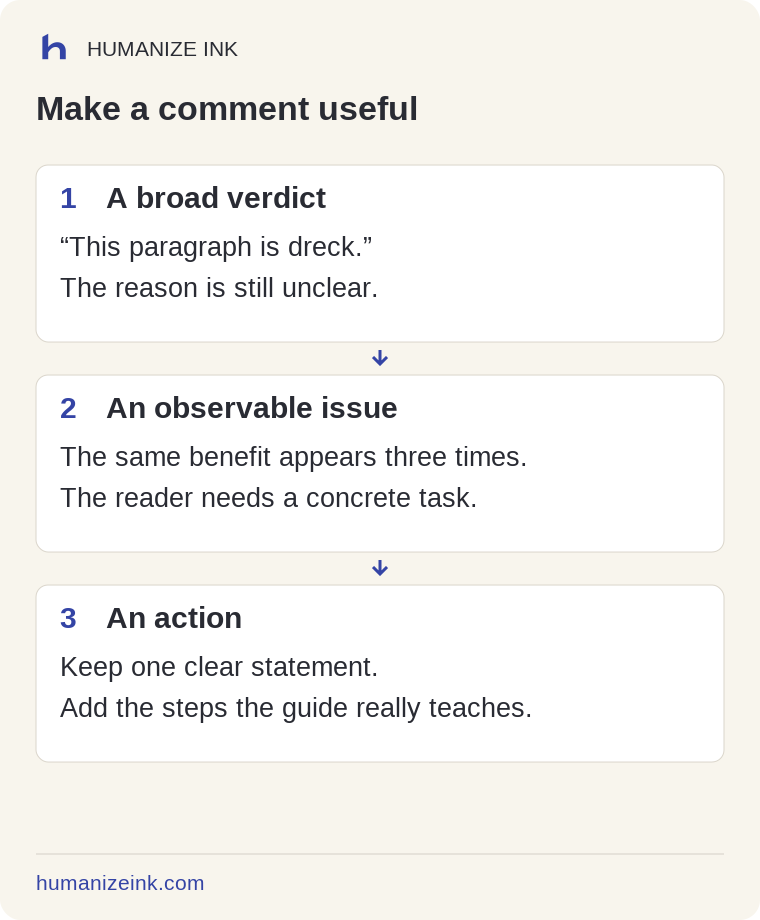
Turn a blunt verdict into actionable feedback
This is an original manual editing exercise. The fictional draft repeats its benefit without giving the reader a decision or an action:
Draft: “Our guide is useful. It gives useful help for useful planning. Readers can use it to make plans.”
Start by naming the issue: useful appears three times and planning/plans repeats the same broad idea. Next identify the missing information: who the guide serves and what it helps them do. Suppose the confirmed purpose is planning a weekly team meeting.
Edited: “Use the guide to plan a weekly team meeting: choose an agenda, assign each item an owner, and record the decisions.”
The edit relies on that supplied purpose. In your own draft, verify the functions before adding them. A precise sentence works because its details are accurate and relevant, rather than because it sounds more polished.
 Original manual example
Replace a repeated benefit with the real task
Draft
Our guide is useful. It gives useful help for useful planning. Readers can use it to make plans.
Edited
Use the guide to plan a weekly team meeting: choose an agenda, assign each item an owner, and record the decisions.
- Confirmed brief: a weekly team-meeting guide
- Repeated word: useful
- Added detail must match the actual guide
humanizeink.com
Review the change against the task
Check the claim
Compare each new detail with the brief. If the guide really covers agendas but says nothing about recording decisions, revise the sentence to match. Specificity earns trust when it reflects the material.
Check the reader’s next step
Ask a reader what they would do after the paragraph. If they can identify the action and its purpose, the edit has solved a communication problem. A shorter paragraph can still need a missing date, requirement or source.
For repetition, paste a before-and-after pair into the word frequency counter. Inspect the repeated words, then return to the sentences. For a broader pass on inflated or repetitive prose, follow the unslop editing guide. Keep the meaning and evidence visible throughout the edit.
Frequently asked questions
What does dreck mean?
In the informal quality sense, it means material someone regards as very poor quality. The surrounding explanation tells you why they judge it that way.
How do you pronounce dreck?
It is one syllable, rhyming with wreck: /drek/.
Is dreck a noun?
Yes. Cambridge treats the ordinary poor-quality-material sense as uncountable. Expressions such as some dreck or a pile of dreck fit that use.
Can I use dreck in a professional review?
A deliberately blunt review may use it. Add a specific example and explain your standard so readers can assess the judgment.
What is a more precise alternative to dreck?
Name the problem: repetitive wording, an unsupported claim, an unclear sequence or a missing instruction. The right phrase depends on the actual material.
How do I turn that criticism into a revision?
Identify one observable issue, state what the reader needs, then give an action. For example, replace a repeated benefit with the concrete steps the guide actually teaches.