

Looking for free parafrase tools? The usual English term is paraphrasing tools: tools that help express a passage in different words while preserving its meaning. Start with one paragraph and a clear purpose, such as simplifying an invitation or making a work email easier to scan.
Choose a tool for the editing job
A useful free option provides enough input space for your passage, appropriate editing controls and a result you can review. Compare those conditions before judging a rewrite. The following guide separates published tool features from an original manual exercise you can use to check your own text.
Two rewriting options and a local checking tool
Scroll to see all columns
| Tool | Published or current site conditions | Useful next step |
|---|---|---|
| QuillBot Paraphraser | Help Center lists the free account’s 125-word limit and Standard/Fluency modes | Try a short paragraph in an appropriate mode |
| Humanize Ink | English; up to 1,200 words and 8,000 characters per attempt; 3 attempts an hour and 10 a day per network, subject to shared availability | Compare the result with the original and edit it locally |
| Humanize Ink Word Frequency Counter | Local word counts and before/after comparison | Inspect repeated words after editing |
The QuillBot Help Center lists the free account conditions, including its 125-word limit and two modes. Humanize Ink's limits page explains its separate network and shared limits. The counter measures wording; the two rewriting services change wording. Choose the function that matches the part of the task you are doing.
Short text and quick alternatives
A request limit matters when your paragraph is close to the maximum. Choose a coherent passage rather than cutting in the middle of a qualification. If a service offers several alternatives, compare them against the same source facts before selecting one.
Longer passages and document context
For a longer draft, divide by section or argument. Keep the paragraph before and after the edited passage available as context. Read the joins when you put the document together: repeated introductions, changed terminology and missing transitions often become visible there.
Write down the facts to preserve
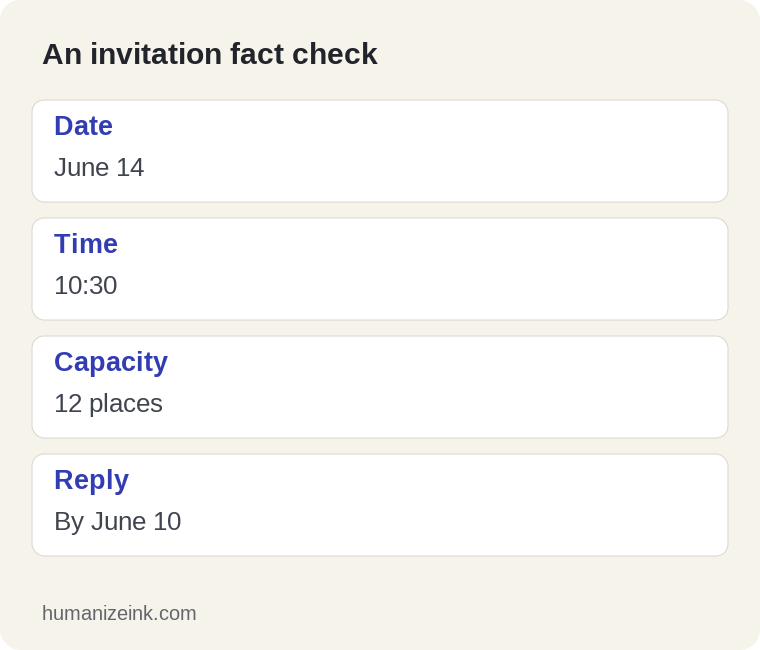
Before changing the language, list the details that carry meaning. For an invitation, that might be the date, time, capacity and reply deadline. For a research paragraph, it might be a numerical result, a qualification and a citation marker.
Use this fictional exercise:
- The workshop is on June 14 at 10:30.
- It has 12 places.
- Readers should reply by June 10.
- The task is to make the invitation shorter and easier to read.
This small list is your acceptance test. You can change the opening, sentence length and order of information while checking that all four requirements remain visible. Keep an especially close eye on quantities: “12 places” describes capacity, while “12 people have booked” describes a different fact.
Compare an original manual edit
These are original manual samples. The revision removes a long introductory phrase and gives the reader a direct action. The date, time, capacity and reply deadline remain intact. A service-generated alternative can be assessed with exactly the same checklist.
 Original manual example
Shorter wording; the same four facts
Draft
We would like to take this opportunity to let you know that the workshop will take place on June 14 at 10:30, that there are 12 places available, and that we would appreciate it if you could send your reply by June 10.
Manual revision
The workshop is on June 14 at 10:30, with 12 places available. Please reply by June 10.
- June 14 at 10:30; capacity of 12 places.
- Reply deadline: June 10.
humanizeink.com
Give a rewrite a clear direction
A bounded instruction helps the reader and the tool focus on the same task. You can adapt this original editing brief:
Make this invitation concise and friendly.
Keep June 14, 10:30, the capacity of 12 and the June 10 reply deadline.
Use plain English and a clear final request.
Keep the facts and the relationship between the dates unchanged.
In Humanize Ink's English editor, choose a tone, reading level and rewrite strength for your intended reader. A lighter pass is a useful starting point when you want small changes. Review the result alongside the original, use the changes view if helpful and save your local edits before copying the final text.
Use nonsensitive material and read the chosen service's privacy details before sending a draft. Humanize Ink's privacy page explains how rewriting differs from its locally calculated text tools.
Check repetition after checking meaning
Once the practical details are correct, look at repeated wording. “The workshop has twelve places. The workshop starts at 10:30” repeats workshop twice. “The workshop has twelve places and starts at 10:30” uses it once. Both versions keep the same two facts.
Open the word frequency counter if you want a systematic comparison. A smaller count is a visible change in wording; its usefulness depends on whether the passage reads clearly. Repetition can help a reader follow a technical term, a key instruction or a deliberately repeated phrase.
Handle source material responsibly
When paraphrasing someone else's ideas, keep the source attribution required by your context. Changing the words leaves the underlying idea connected to its source. Compare the revised passage with the original and the source, especially when numbers, technical terms or quotations appear.
For a long document, review one section at a time and finish with a complete read-through. The guide to keeping formatting shows how to check structure when transferring edited text. Save a final copy that you have personally checked for meaning, readability and practical details.
Frequently asked questions
What does free parafrase tools refer to?
It is a search phrase for free paraphrasing tools. A paraphraser helps express a passage in different words while you review that the meaning and attribution remain correct.
What are QuillBot’s published free paraphrasing limits?
Its official Help Center lists a free-account limit of 125 words and the Standard and Fluency modes. Check the current page for access conditions before planning a longer editing session.
What are Humanize Ink’s current free limits?
The editor accepts up to 1,200 words and 8,000 characters per attempt. Availability includes 3 attempts an hour and 10 a day per network, plus a shared limit.
How can I paraphrase a longer document?
Work through coherent sections while keeping adjacent paragraphs and the original document available. Finish with a full read-through to check terminology, transitions and repeated introductions.
Does paraphrasing replace a citation?
Keep attribution for ideas and source material according to your context. Review quotations, numbers and technical terms against the original source.
How should I check a rewrite before using it?
Use a fact checklist first, then read for clarity and repetition. The manual invitation example preserves its date, time, capacity and reply deadline while shortening the opening.