


A masked ball is a formal dance at which guests wear masks. Cambridge Dictionary’s masked ball entry gives this meaning. Here, ball means a formal dancing event, and masked describes the guests’ appearance.
If you are reading a novel, the phrase gives you a setting. If you are writing an invitation or a scene, it gives your reader a starting expectation: dancing, a formal occasion, and masks. The specific dress, customs, and meaning come from the event or the text around it.
Understand the two words together
English uses ball for both a round object and a formal dance. In masked ball, the event meaning applies. Useful surrounding verbs include attend, host, invite, dance, and arrive. “They attended a masked ball” describes going to an event.
Masked is the adjective. The phrase describes people wearing masks at that dance. It leaves the exact style open: a passage might mention a half-mask, an elaborate face covering, or matching masks chosen by the host. Use those details when they appear in the source you are reading.
An original example is “Guests arrived at the masked ball carrying silver invitations.” A second sentence can develop the scene: “Leah recognized her brother by the torn cuff of his coat.” The mask creates one source of uncertainty; the cuff gives the reader a specific way someone becomes recognizable.
Masked ball and related expressions
Masquerade ball is a closely related expression. Cambridge’s masquerade entry also gives a party involving masks or disguises. Read the complete phrase when deciding whether a passage refers to an event or uses masquerade figuratively.
Scroll to see all columns
| Expression | What it usually directs attention to | What to check next |
|---|---|---|
| Masked ball | A formal dance with masks | The invitation or scene’s dress and event details |
| Masquerade ball | A dance involving masks or disguise | How the text describes the disguise |
| Costume party | Guests dressed as characters or in chosen outfits | Whether the invitation also requests masks |
| Masked guest | One person wearing a mask | Which event they are attending |
| A masquerade | A party, or a figurative show or disguise | The surrounding sentence |
These distinctions help you ask the right follow-up question. For an actual invitation, the host’s dress instructions take priority. For a story, the author’s details determine how the gathering looks and what happens there.
Read an invitation literally
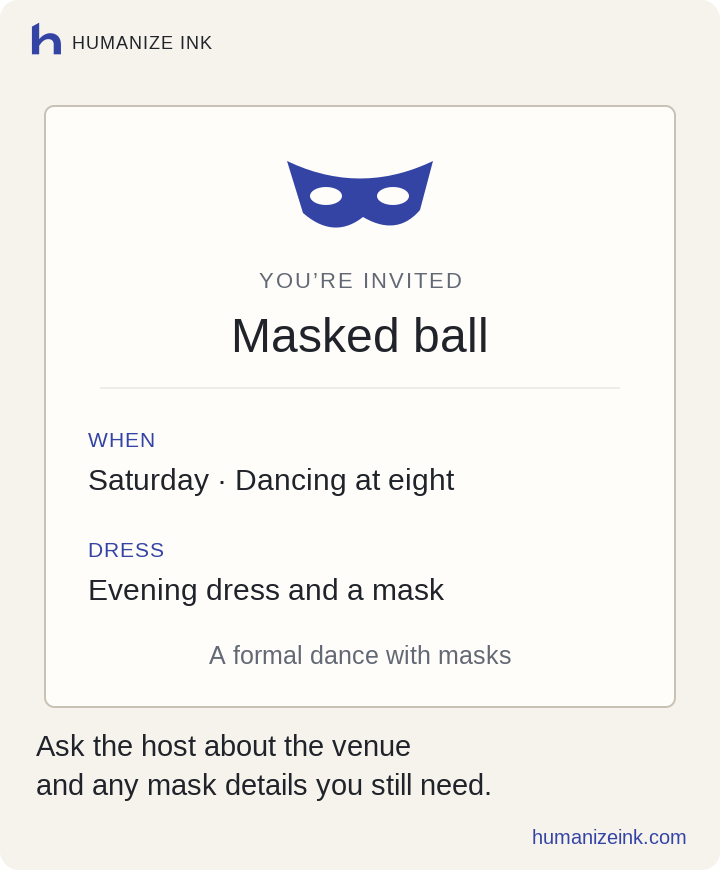
Suppose an original sample invitation says: “Join us for a masked ball on Saturday. Evening dress and a mask are requested. Dancing begins at eight.” The invitation supplies three useful facts beyond the event name: the day, the dress request, and the starting time for dancing.
A clear reply can ask about the remaining practical detail: “Would a half-mask be suitable?” If you are writing the invitation yourself, include the information a guest needs to prepare. Name the venue and time, explain the dress expectation, and give a contact for questions.
Read a fictional scene for evidence
In a novel, masks can support mistaken identity, privacy, playfulness, or a character’s deliberate performance. Treat these as possible effects of the scene. Decide which interpretation the text supports by looking at actions, dialogue, and what the narrator tells you.
For the Leah example above, a useful comment is “The mask makes recognition uncertain, while the torn cuff gives Leah a clue.” It identifies the visible evidence and explains the effect. A broader claim about the whole novel would need evidence from other scenes too.
Write a clear description of a masked ball
Start with the event, then choose details through a particular observer. A new guest might notice the room’s layout and where to put a coat. A musician might notice the floor’s rhythm and the pauses between dances. A character searching for someone may watch hands, posture, or familiar clothing.
Try this original scene opening:
“At the masked ball, Mara kept to the edge of the floor. She was looking for a green ribbon tied around a guest’s wrist. Every time the dancers turned, the ribbon disappeared into the crowd.”
The three sentences establish the event, a purpose, and a small obstacle. You can picture what the character is doing. Decorative details become more effective when they support that action.
For a starting situation, try the short story prompt generator. Use one as a starting point, then decide what your particular character wants and what they can observe.

Check grammar and capitalization
Use a masked ball for one event and masked balls for more than one. In an ordinary sentence, lower case works: “The hotel hosted a masked ball.” Capitalize the words when they form part of a specific event’s official name, following the host’s usage.
The common phrase is masked ball, with the adjective masked. “Mask ball” may appear as a chosen event name; preserve a proper name when quoting it. When explaining the general event in your own prose, masked ball gives the reader the familiar dictionary phrase.
Turn a definition into a useful reading note
Write one sentence defining the event and another explaining its role in the passage. For example: “A masked ball is a formal dance where guests wear masks. In this scene, Mara uses a green ribbon to identify the guest she is seeking.” This separates the word’s meaning from your interpretation of a particular scene.
Frequently asked questions
What does masked ball mean?
A formal dance at which guests wear masks. The invitation or story supplies the event’s particular dress and customs.
Is a masked ball a masquerade ball?
The expressions are closely related and often describe the same kind of event. Read the host’s instructions or the passage for the specific disguise and dress details.
Does everyone wear a costume?
That depends on the event. A host may request evening dress and a mask, themed costumes, or another dress code. The name alone leaves those details open.
What does a masked ball symbolize in a story?
Look at what the characters do. Masks may support concealment, mistaken identity, play, or social performance. Explain the interpretation using details from the particular scene.
How do I use masked ball in a sentence?
“The museum hosted a masked ball after the exhibition opened.” Hosted makes it clear that ball refers to an event.
Should masked ball have capital letters?
Use lower case for the general event. Follow the host’s capitalization when quoting the official name of a particular ball.