

Mottle means to mark a surface with irregular areas of different color. In everyday descriptions, you will often meet mottled: a mottled surface has a patchy, varied appearance. Think of an old stone with gray and brown patches, or a ceramic glaze whose colors vary across the surface. Cambridge Dictionary’s mottle entry gives the underlying color-pattern meaning.
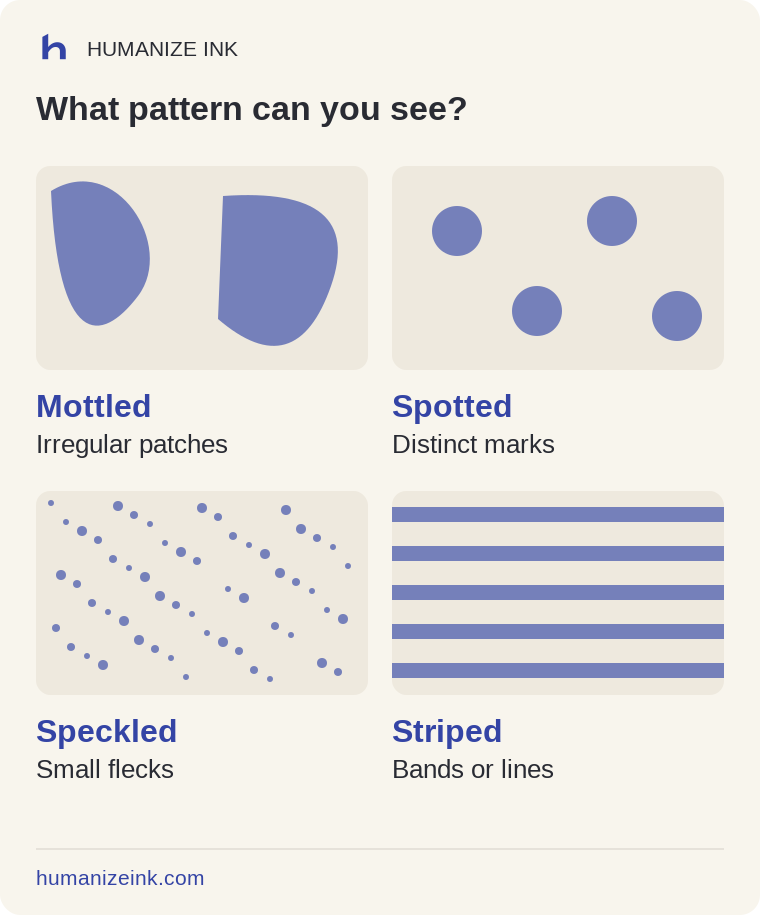
The useful detail is the arrangement: the colors form an uneven pattern. This guide uses original writing examples and schematic swatches to help you choose between mottled, spotted, speckled and striped, then turn a vague description into a sentence a reader can picture.
Start with the visible pattern
A mottled wall might have uneven areas of cream, gray and brown. A mottled leaf might show patches of lighter and darker green. The word describes the varied appearance; the surrounding sentence can explain the colors, material and location.
Compare these original descriptions:
- “A mottled gray stone held the gate open.”
- “The bowl had a mottled blue-and-white glaze.”
- “Light through the branches mottled the path.”
In the first two, mottled describes a noun. In the third, mottled is a past-tense verb describing the effect of light. Whether a patch comes from pigment, shade or wear depends on the scene. If its cause matters, name the cause rather than asking the pattern word to explain it.
Choose between mottled, spotted, speckled and striped
These words help readers picture different arrangements. Everyday patterns overlap, so use the distinction as a writing aid and check the actual object.
Scroll to see all columns
| Word | Pattern to look for | Original phrase |
|---|---|---|
| Mottled | Irregular patches or areas of different color | Mottled gray plaster |
| Spotted | Distinct marks that stand apart from the background | A scarf with large blue spots |
| Speckled | Many small flecks or dots | Speckled cream paper |
| Striped | Bands or lines | A blue-and-white striped cloth |
Choose the scale of detail
From across a room, a vase may look mottled. Close up, you may notice tiny flecks inside broad patches. Choose the level that matters to your reader. A shop description might mention both: “A cream vase with broad blue patches and fine dark speckles.” A passing reference in a story may need only “the mottled vase.”
Match the word to the object
Read the noun and adjective together. “Mottled blue glaze” gives a useful picture because glaze can have visible color variation. “A mottled decision” asks the reader to interpret a metaphor. That creative use needs supporting context. For instructions, observation notes and product descriptions, a literal surface usually gives the clearest starting point.
Use mottle, mottled and mottling accurately
The usual verb forms are mottle, mottles, mottled, mottling. The final silent e drops before -ing.
Scroll to see all columns
| Form | Original sentence | Job in the sentence |
|---|---|---|
| Mottle | Shadows mottle the courtyard. | Present-tense verb with a plural subject |
| Mottles | Afternoon light mottles the stone floor. | Present-tense verb with a singular subject |
| Mottled | The years had mottled the painted sign. | Past participle after had |
| Mottled | A mottled sign hung above the door. | Descriptive adjective |
| Mottling | The glaze shows blue mottling near the rim. | Noun naming the varied appearance |
You can often make a sentence more direct by naming the source of the pattern: “Shadows mottled the wall” has a different emphasis from “The wall was mottled with shadow.” The first follows the moving light; the second presents the wall. Choose the viewpoint that fits the paragraph.
Make a description useful to its reader
Here is an original manual editing exercise:
Draft: “The thing had a mottled and interesting look.”
Edited: “The ceramic bowl had a cream glaze with irregular blue patches around the rim.”
The edit identifies the object, its material, the colors and the location of the patches. It trades a general impression for details a buyer or observer can use. In a story, a shorter version may work better: “She turned the mottled blue bowl in her hands.” The action already supplies the context.
For your own sentence, first underline the object. Next circle the color words. Finally ask which feature helps the reader: the pattern itself, its location, its scale or its cause. Keep the two or three details that serve that purpose.
 Original manual edit
Give the pattern an object and a location
Draft
The thing had a mottled and interesting look.
Edited
The ceramic bowl had a cream glaze with irregular blue patches around the rim.
- Object: ceramic bowl
- Colors: cream and blue
- Location: around the rim
humanizeink.com
Review a longer descriptive passage
If every object is mottled, the word starts to lose its identifying value. Read the whole paragraph and keep it where the pattern matters most. Elsewhere, a plain noun can carry the reference: bowl, wall, stone or leaf.
To practice a description in verse, choose an object or place with the poetry prompt generator, then write your own lines around one concrete image.
You can use the word frequency counter to locate repeated descriptive words in a passage. Paste the draft, inspect the count, then read each occurrence in context. A lower count is useful only when the revised passage still gives the reader the needed picture. Keep exact terms when they identify the same object across an instruction or scene.
Frequently asked questions
What does mottle mean in simple English?
To mark something with irregular areas of different color. Mottled describes the resulting patchy appearance.
What is a mottled appearance?
An uneven color pattern, such as gray and brown patches on a stone. Add the colors or their location when the reader needs a more precise picture.
How do I spell the -ing form?
Mottling. Drop the final e in mottle before adding -ing; mottled is the past form and a common adjective.
Are mottled and speckled interchangeable?
They can overlap in a real object. Mottled emphasizes uneven areas of color; speckled draws attention to small flecks or dots. Choose the feature relevant to the description.
Can light mottle a surface?
Yes. “Shadows mottled the path” describes an uneven light-and-dark pattern. The sentence identifies shadows as the source.
How can I use mottled in a product description?
Name the item and visible colors: “A ceramic bowl with a mottled blue-and-cream glaze.” Include measurements separately when size affects the purchase.