

An octonion is an element of an eight-dimensional number system over the real numbers. You can describe one using eight real components. Octonion multiplication is generally noncommutative and nonassociative: order and grouping can affect a product.
John C. Baez’s mathematical introduction provides the formal background. This guide helps a reader understand the word, decode a small example and write an accurate plain-English explanation. The diagrams visualize component notation and the steps for reading it.
Start with the word and the object it names
Use an octonion for one element and octonions for the plural or the number system in general. In ordinary mathematical prose, the word is lowercase unless it begins a sentence or belongs to a title. A sentence such as “Let x be an octonion” introduces one mathematical object.
The eight components describe that one object. This is the important distinction behind the definition. Saying “an octonion is eight numbers” can leave a reader unsure whether you mean a list, eight separate objects or an element of a particular algebra. “An octonion has eight real components” is a clearer starting point.
In a technical passage, look for the notation and operations the author defines. The word tells you the kind of object under discussion. The surrounding definitions explain how the author writes and works with it.
Read an eight-component example
A common expression is x = x₀ + x₁e₁ + x₂e₂ + … + x₇e₇, with real coefficients. The basis is 1, e₁, e₂, e₃, e₄, e₅, e₆, e₇, as set out in Baez’s construction.
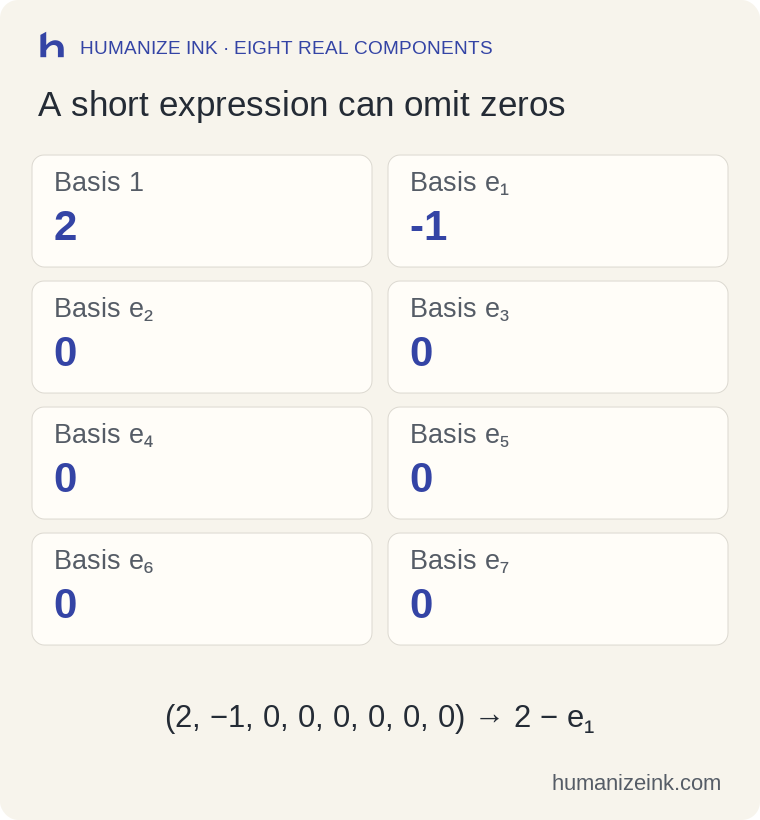
For an original reading exercise, take the coefficient list (2, −1, 0, 0, 0, 0, 0, 0). It describes 2 − e₁ in that basis. The zero coefficients remain part of the eight-component representation even when the shorter expression leaves their terms unwritten.
Count the components, not the printed terms
The expression 2 − e₁ shows only two nonzero terms. It still names an octonion with eight real coefficients in the chosen basis. A concise expression can omit zeros without changing the kind of mathematical object. In an explanatory caption, make clear which representation you are showing.
Keep coefficients and basis elements distinct
In −1e₁, the real coefficient is −1 and the basis element is e₁. That distinction helps a beginner read the notation without treating every subscript as another multiplication instruction. It also helps an editor preserve a formula while improving the sentence around it.
Compare real, complex, quaternion and octonion descriptions
These familiar names form a useful orientation table. The dimensions below are over the real numbers. They tell you how many real coordinates are needed to describe an element, not how many items a particular line of notation must print.
Scroll to see all columns
| System | Real components | A reading cue |
|---|---|---|
| Real numbers | 1 | A single real coordinate |
| Complex numbers | 2 | Real and imaginary components |
| Quaternions | 4 | Four real components |
| Octonions | 8 | Eight real components |
Baez discusses these four systems as normed division algebras. The table is an orientation aid; the algebraic rules still matter. An arbitrary list of eight values becomes an octonion representation when a basis and the relevant operations have been specified.
Understand why grouping matters
For real-number multiplication, the associative rule lets you regroup a three-factor product. Octonions do not satisfy that rule in general. (ab)c and a(bc) can differ. Parentheses therefore carry information that an editor should preserve.
This does not mean every possible choice of a, b and c produces different results. For example, ordinary real scalars sit inside the system. The useful statement is that the associative law is not valid for all octonions. Baez’s preliminaries explain the formal distinction.
Likewise, noncommutative multiplication means order can matter: ab and ba need not agree. Keep order and grouping as separate ideas in a definition. Swapping the factors changes order; moving parentheses changes grouping.
Turn a compressed definition into clear prose
Draft: “Octonions are eight numbers where multiplication never works normally.”
Manual revision: “An octonion has eight real components. Its multiplication can depend on the order of the factors and on how a product is grouped.”
The original draft blurs one object with its components and uses an absolute claim. The manual edit names the two relevant properties without implying that every individual multiplication breaks familiar rules. It gives a reader a more useful question to ask when they return to the formal source.
For a technical document, keep the formal definition and any chosen multiplication convention nearby. A plain-English explanation supports that definition; it should preserve the source’s scope and notation. In particular, leave parentheses, subscripts and minus signs intact unless you are deliberately correcting them against a reliable mathematical source.
 Original manual example
Keep one object and its properties clear
Draft
Octonions are eight numbers where multiplication never works normally.
Manual revision
An octonion has eight real components. Multiplication can depend on order and grouping.
- Eight counts real components.
- Can differ preserves the scope of the algebraic claim.
humanizeink.com
Check your own explanation
Read your summary once for vocabulary and once for mathematics. Confirm that octonion names one object, eight counts real components, and the claims about multiplication say what can differ. Compare every formula directly with the source before sharing it.
For language editing, paste the surrounding English prose into the rewriting editor and keep the formula in your original document. Check technical terms and any claims after a rewrite. Humanize Ink edits English wording; its text tools do not verify octonion identities or compute products.
Frequently asked questions
What does octonion mean in simple terms?
One element of a number system described by eight real components. The multiplication rules include order and grouping effects.
Is an octonion the same as eight separate numbers?
The eight real values are coefficients describing one element in a chosen basis. The algebra also specifies operations on those elements.
Why can 2 − e₁ count as an octonion?
Its remaining coefficients can all be zero. A shorter expression can omit zero terms while the underlying representation still has eight real components.
What does nonassociative mean here?
The products (ab)c and a(bc) can differ. Preserve the parentheses when reading or editing a formula.
Does every octonion product change when regrouped?
No. Nonassociativity means the law does not hold for every choice of elements. Particular choices can still give the same result.
Can Humanize Ink check an octonion calculation?
Use a mathematical reference or suitable calculation software for that task. The existing editor helps revise English prose, which you should compare with the original formulas.