

Prate means to talk at length in a way the speaker or narrator regards as foolish or unimportant. Cambridge Dictionary labels it old-fashioned and gives the pronunciation /preɪt/, rhyming with late.
The word carries a judgment as well as a description of speech. “He prated about his plans” presents those plans through an impatient or dismissive viewpoint. This guide uses original sentences to explain the grammar, the effect on tone, and a practical way to choose between prate and a more neutral verb.
What prate tells the reader
In “The mayor prated about his grand ambitions,” the writer gives us more than a topic. The verb suggests that the speech is excessive, foolish or of little value. That makes prate useful when a narrator’s attitude matters.
Compare two original versions:
- “The mayor spoke about the town’s future.” This mainly reports the topic.
- “The mayor prated about the town’s future.” This also conveys a dismissive view of the speech.
The second sentence may suit satire or an irritated character. A factual meeting summary needs more evidence about what was said and why it mattered. Choose the verb after deciding whose judgment the sentence should express.
Build the sentence: prate about and prate on
Prate commonly stands on its own or takes a phrase introduced by about. “Prate on” emphasizes the continuation of the talk. Cambridge treats it as an intransitive verb.
Scroll to see all columns
| Pattern | Original example | Effect |
|---|---|---|
| Prate | Let him prate; we have work to finish. | Dismisses the speech as a whole |
| Prate about something | She prated about a title she hoped to inherit. | Names the topic being dismissed |
| Prate on about something | He prated on about his supposed influence. | Emphasizes continuing speech |
Keep the topic after about
“They prated about the proposal” is a clear pattern to follow. If you want to name the words themselves as an object, choose a verb that naturally takes that object: “They repeated the slogan.” The first sentence judges a conversation; the second identifies a concrete verbal action.
Give on a purpose
“Prated on” already suggests continuation. If the sentence also says endlessly, at great length, for ages, consider which detail earns its place. A specific duration can be useful: “He prated on for twenty minutes while the train stood at the platform.” The time gives the reader a scene rather than a stack of similar judgments.
Spell and pronounce the verb forms
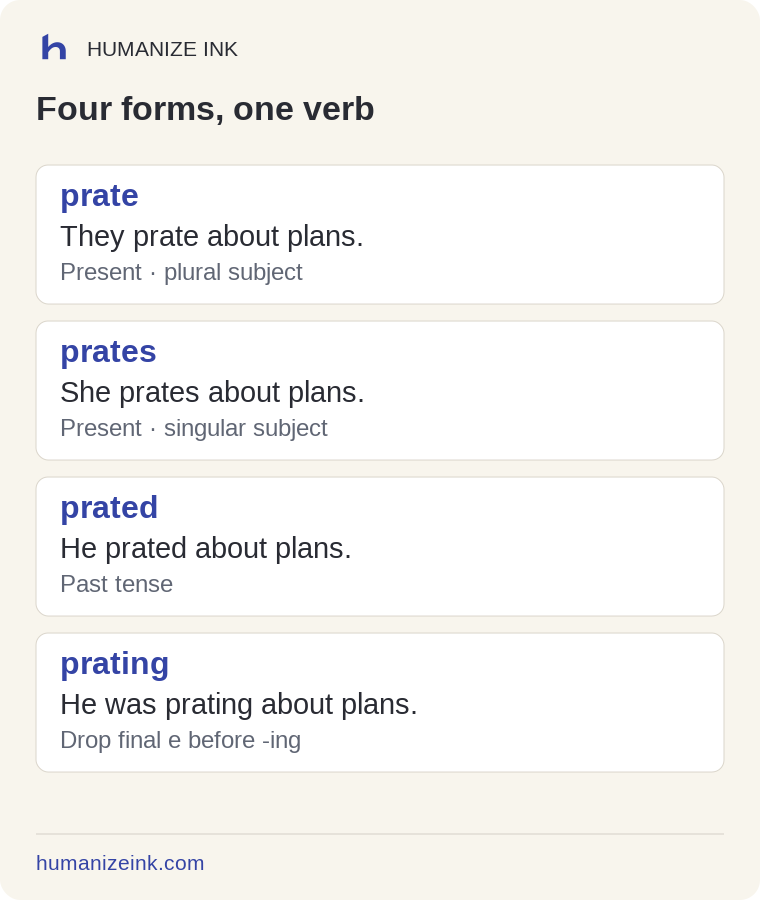
The forms are prate, prates, prated, prating. Drop the final e before -ing. Say prate like prayt, in one syllable. The American Heritage entry lists the inflected forms and supplies another dictionary reference.
Use the form required by the sentence: “I prate,” “she prates,” “they prated,” and “he was prating.” The tense identifies when the speech happens. Its dismissive coloring remains a separate choice.
In an older text, check the whole sentence before modernizing it. An unusual verb may help establish a character’s era or attitude. A plain-language explanation for a reader can use “talked on about matters the narrator considered trivial,” while an edition or quotation should preserve the original wording accurately.
Compare prate, prattle, chatter and speak
The words share an association with talk, but they offer different starting points. Context supplies the final tone.
Scroll to see all columns
| Word | Useful choice when… | Original sentence |
|---|---|---|
| Prate | A dated, dismissive voice is deliberate | The count prated about his importance. |
| Prattle | The talk feels inconsequential or childlike | She listened to the child prattle about his game. |
| Chatter | The focus is informal or continuous conversation | Guests chattered beside the fire. |
| Speak or talk | The sentence mainly reports an action | He spoke about the revised route. |
Read a candidate verb inside the whole paragraph. The same narrator who affectionately describes a child may mock a pompous adult. A thesaurus gives alternatives; the scene tells you which attitude belongs there.
Edit a judgment into useful feedback
Suppose you are reviewing a colleague’s draft. This original manual example starts with a dismissive comment:
Draft feedback: “You prate on about the project’s goal in the introduction.”
Edited feedback: “The introduction repeats the project’s goal in three sentences. Keep the clearest version and move the deadline into the next paragraph.”
The edit identifies an observable problem and a next step. It is useful when the goal is collaboration. If the goal is fictional characterization, you may intentionally keep prate to reveal impatience, snobbery or irritation. The two choices serve different readers.
 Original manual edit
Move from a judgment to an action
Dismissive feedback
You prate on about the project’s goal in the introduction.
Specific feedback
The introduction repeats the project’s goal in three sentences. Keep the clearest version and move the deadline into the next paragraph.
- Observation: the goal appears three times
- Action: retain one version
- Next detail: put the deadline nearby
humanizeink.com
Check who owns the attitude
Before keeping prate, answer three questions: Who considers the speech unimportant? Does the surrounding scene support that attitude? Would the intended reader recognize the dated register?
For neutral reporting, name what happened: a repeated claim, an extended digression or a missing answer. For a voiced narrator, keep the judgment when it is doing purposeful work. To explore another word whose attitude changes with context, read the guide to snark.
Frequently asked questions
What does prate mean in simple English?
To talk at length about things regarded as foolish or unimportant. The word also communicates a dismissive attitude toward the speech.
How do you pronounce prate?
It rhymes with late: /preɪt/. Cambridge provides UK and US audio if you want to hear it.
Is prate an old-fashioned word?
Yes. Cambridge labels it old-fashioned. That register can suit an older text, satire or a deliberately voiced narrator.
What are the past tense and -ing form?
Prated and prating. The final e drops before -ing; the present-tense third-person form is prates.
Should I write prate about or prate something?
Prate about a topic is the useful pattern here: “He prated about his plans.” Choose a transitive verb such as repeated when you want a direct object.
Is prate suitable for work feedback?
Use it when a deliberately dismissive voice is intended. For collaborative feedback, identify the repeated material and give a concrete revision step.