


Sixpence means six old pence in British pre-decimal money, or the coin worth that amount. A sixpence was half a shilling. In an older story, “It cost sixpence” gives a price; “She held a sixpence” refers to a coin.
The Royal Mint Museum’s account of the sixpence traces its introduction to 1551 and records its withdrawal from monetary use in 1980. For readers and writers, the immediate task is usually simpler: identify whether a passage means a sum, an object, or an expression.
Recognize the amount and the coin
Sixpence can name a price or a physical item. The surrounding verb usually makes the meaning clear. In “The notebook cost sixpence,” cost introduces an amount. In “A sixpence rolled beneath the cupboard,” the article a and the verb rolled point to a coin.
Scroll to see all columns
| Phrase | What it refers to | How to read it |
|---|---|---|
| It cost sixpence. | An amount of money | The price was six old pence. |
| She found a sixpence. | One coin | She found a coin of that denomination. |
| He counted two sixpences. | Two coins | Together they were worth one shilling. |
| The tag reads 6d. | A written price | The d marks old pence. |
| The price was 1s 6d. | One shilling and sixpence | Twelve plus six: eighteen old pence. |
The Bank of England’s old-money converter converts old-money amounts into decimal values and links to a separate inflation calculator for purchasing-power comparisons. In the old system, a pound contained twenty shillings and a shilling contained twelve pence.
Work through a simple price
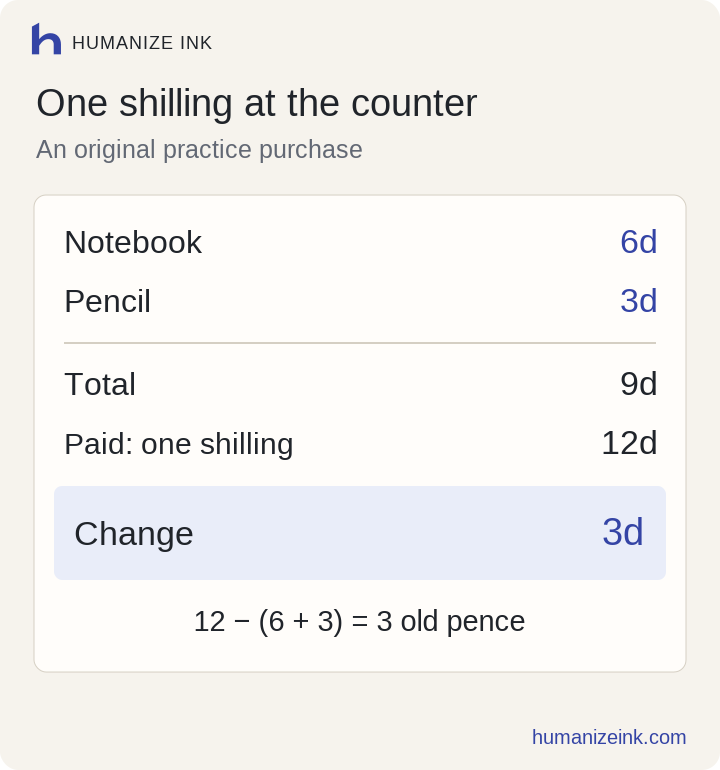
Imagine an original story exercise in which a notebook costs sixpence and a pencil costs threepence. The total is nine old pence. A character who pays with one shilling, worth twelve old pence, receives three old pence in change.
This calculation gives the scene internal consistency. It says nothing by itself about whether the notebook is cheap for that character. To make that judgment, you would need the story’s date, place, and relevant wages or prices.
Read a mixed amount
For two shillings and sixpence, calculate two times twelve, then add six: thirty old pence. A line of dialogue might shorten this to “two and six.” When your audience needs help, introduce the full amount before using the shorter expression.
Keep the old and decimal systems visibly separate in your notes. Using the old units, sixpence is 6/240 of a pound, equivalent to 2½ decimal pence. That is a face-value relationship. It does not establish what sixpence from a particular historical year could buy today.
Use the word naturally in a sentence
For an amount, write “sixpence” without adding a plural ending: “The admission was sixpence.” For several coins, “sixpences” is useful: “Three sixpences lay on the counter.” If you want to emphasize the physical object, sixpenny piece or sixpence coin can also make the reference clear.
The nickname tanner may appear in British dialogue. The Royal Mint Museum records this nickname in its account of the coin. If you explain it in a reading note, a short gloss such as “a tanner, or sixpence” gives the reader enough to continue.
In your own historical fiction, decide who is speaking. A narrator introducing the money system can use the fuller description. Characters who already understand it may speak more briefly. Keep their language consistent with the place and period you have researched.


Explain an older passage to a modern reader
Consider this original sentence: “Ada put down a sixpence and waited for the bookseller to count the change.”
If you are annotating the passage, write: “A sixpence was a British coin worth six old pence, half a shilling.” That explains the object and its relationship to a larger unit. If the passage gives the purchase price, you can also calculate the change.
If you are adapting the passage for a younger reader, preserve the setting with a small explanation: “Ada put down a sixpence, a small coin worth half a shilling.” Replacing it with a modern price would change the monetary setting. Add that kind of comparison in a note only when you have a dated source and a stated method.
Handle familiar titles and expressions
You may meet sixpence in a book title, a nursery rhyme, a wedding custom, or an idiom. Begin with the literal coin or amount, then examine what it does in that specific work. A rhyme may use it for rhythm or a familiar small sum; a story may use the coin as a keepsake.
The phrase “turn on a sixpence” describes an extremely tight turn. In a report, “The vehicle turned in a very small space” may be clearer for an international audience. In a character’s dialogue, the idiom may suit the voice.
Keep a useful reading note
Record the exact phrase, whether it names an amount or coin, the surrounding transaction, and the work’s date and place. Separate facts supplied by the passage from calculations you make yourself. This small note is usually more useful than assigning the coin a single modern value.
For another example of reading an unfamiliar word through its context, see the guide to astral meaning.
Frequently asked questions
How much was sixpence in old British money?
Six old pence, or half a shilling. A pound contained 240 old pence, so sixpence was one-fortieth of a pound.
Does 6d mean sixpence?
In British pre-decimal prices, yes. The d marks old pence. Read 1s 6d as one shilling and sixpence.
What is the plural of sixpence?
Use sixpences for multiple coins: “two sixpences.” When naming a price, write “it cost sixpence.”
What does tanner mean in old British dialogue?
Tanner is a nickname for a sixpence. A short explanation such as “a tanner, or sixpence” helps a reader follow the passage.
Is an old sixpence the same as six modern pence?
They belong to different currency systems. The historical sixpence had a decimal face value of 2½ new pence after the 1971 changeover.
How do I explain sixpence in a story?
A brief note such as “a British coin worth half a shilling” is often enough. Add a year-specific purchasing-power comparison only when you have a suitable source.