

Stuttgarter can mean a person from Stuttgart, or it can describe something from or associated with Stuttgart. Duden lists the person noun der Stuttgarter separately from the place adjective. The sentence tells you which meaning to use.
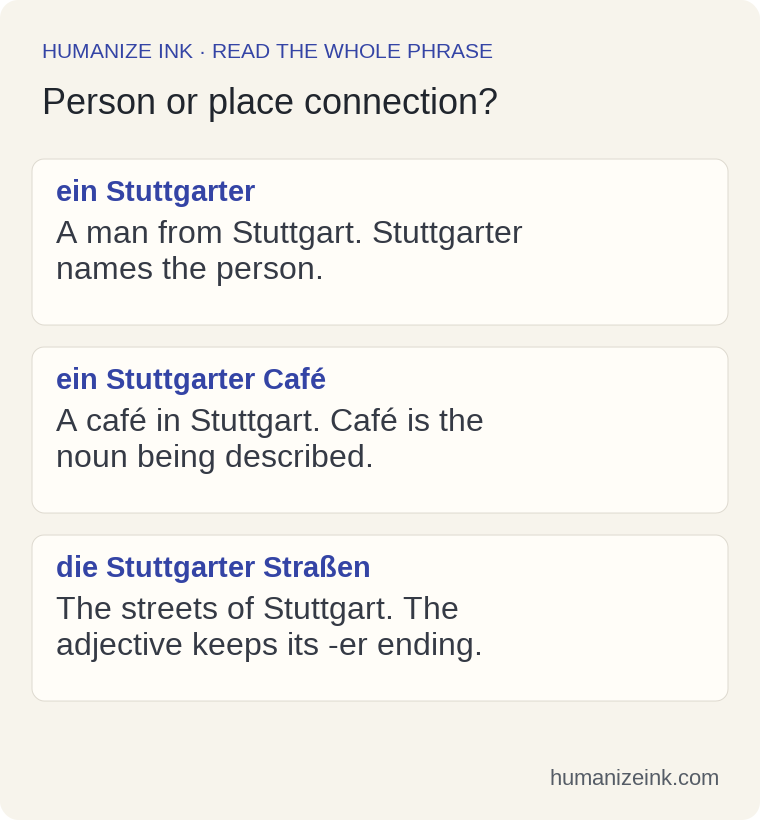
For example, ein Stuttgarter can mean a man from Stuttgart; ein Stuttgarter Café means a café in or associated with Stuttgart. This English-language guide uses original German examples to show the distinction, explain the capital letter and help you translate a complete phrase rather than a word in isolation.
Read Stuttgarter as a person noun
When Stuttgarter names a person, it can stand as the head of a noun phrase. In “Ein Stuttgarter wartet am Bahnhof,” the person is the one waiting: “A man from Stuttgart is waiting at the station.” The place tells you an association, not the person’s profession or personality.
Duden records the masculine forms der Stuttgarter, genitive des Stuttgarters, and plural die Stuttgarter. The plural form looks the same as the basic singular form, so the article and verb help. Compare “Der Stuttgarter wartet” with “Die Stuttgarter warten.” The change from wartet to warten confirms the shift to plural.
In English, a person from Stuttgart or a Stuttgart resident is often easier to understand than carrying the German noun into a general-audience sentence. Choose resident only when residence is what the context means. Someone can be described by their city of origin while currently living elsewhere.
Read Stuttgarter before another noun
In “ein Stuttgarter Café,” Café is the object being described. Stuttgarter supplies the place connection. In this geographical adjective use, the word keeps its -er ending and its capital letter. Duden’s adjective entry records it as indeclinable.
Scroll to see all columns
| German phrase | Natural English rendering | Head of the phrase |
|---|---|---|
| ein Stuttgarter | a man from Stuttgart | The person noun |
| ein Stuttgarter Café | a café in Stuttgart | Café |
| eine Stuttgarter Schule | a school in Stuttgart | Schule |
| die Stuttgarter Straßen | the streets of Stuttgart | Straßen |
Find the word being described
Look beyond the article. Both ein Stuttgarter and ein Stuttgarter Café begin in the same way. If another noun follows, ask whether Stuttgarter describes that noun’s location or association. Reading through to the next verb or punctuation mark helps you find the boundary of the phrase.
Choose the English relationship
English can express the relationship with in, from, of, or an attributive place name. “A Stuttgart school” and “a school in Stuttgart” may describe the same location; “a letter from Stuttgart” emphasizes origin. Use the wider sentence to decide which relationship the writer actually gives you.
Keep capitalization and endings clear
German place-derived adjectives ending in -er have a distinctive pattern. In the geographical use discussed here, Stuttgarter stays capitalized even before a common noun: Stuttgarter Straßen. The following noun follows normal German capitalization too.
The person noun also begins with a capital, as German nouns generally do. This means the capital alone cannot distinguish the two uses. The grammatical job matters more: is the word naming the person, or describing another noun?
When a proper name contains Stuttgarter, retain the organization’s or publication’s official name on first mention and explain it where needed. A place adjective is not enough to identify a particular business, insurer or newspaper. Check the full name rather than assigning the word to the first brand returned in a search.
Translate a short passage in context
Here is an original two-sentence exercise:
German: “Ein Stuttgarter zeigt mir ein Stuttgarter Café. Wir sprechen über die Stuttgarter Straßen.”
English: “A man from Stuttgart shows me a café in the city. We talk about Stuttgart’s streets.”
The first use names the person; the second and third describe places. The English version varies the phrasing to keep the paragraph natural. It retains Stuttgart as the city throughout. The German sentences and English rendering are original, manually authored teaching examples.
For a more literal study note, you could repeat “a café in Stuttgart” instead of “a café in the city.” That version makes the word-to-word relationship easier to trace. The best version depends on whether the reader is learning the grammar or reading a finished narrative.
Edit the English sentence for the reader
Consider the original draft “A Stuttgarter showed me a Stuttgarter café.” For an English reader unfamiliar with the noun, the first occurrence may interrupt the story. “A man from Stuttgart showed me a café in the city” supplies the meaning where it is needed.
Before polishing, choose what matters: origin, current residence or local affiliation. Preserve any difference the German passage makes. An editor can improve the flow after that choice; the source text determines the relationship.
Use the English rewriting editor on your English draft if you want a language pass, then compare place names and pronouns. Keep the German source beside your document. Humanize Ink’s editor rewrites English drafts. Use the explanations and source links in this guide to establish the German meaning before editing your English version. For another context-dependent adjective, read Cartesian meaning.
 Original manual example
Make the place relationship clear
English draft
A Stuttgarter showed me a Stuttgarter café.
Manual revision
A man from Stuttgart showed me a café in the city.
- The first phrase names the person.
- The second phrase locates the café.
humanizeink.com
Frequently asked questions
What does Stuttgarter mean in English?
As a person noun, a person from Stuttgart; as a geographical adjective, from or associated with Stuttgart. Choose the natural English phrase from the complete sentence.
Why does Stuttgarter have a capital letter before Café?
German geographical adjectives ending in -er keep a capital letter in this use. The following noun, Café, is capitalized under the normal German noun rule.
How do I recognize the plural person noun?
Duden gives die Stuttgarter as the plural. The article, verb and surrounding sentence help distinguish it from the singular.
Does Stuttgarter always mean a current resident?
The exact relationship depends on context. Someone may be associated with Stuttgart by origin while living elsewhere; choose resident when the passage specifically supports residence.
Does Stuttgarter refer to a particular company?
The word alone is a city-related noun or adjective. A company or publication requires its complete proper name and context.
Can Humanize Ink translate the German example?
The examples here are manually authored and explained. The existing rewriting editor is for English drafts; use it after you have established an accurate English meaning.