

Talkie 1930 is a vintage-language-model project built around English material from before 1931. Its April 2026 announcement, by Nick Levine, David Duvenaud and Alec Radford, describes a 13-billion-parameter model and research into what historical training material changes about a model's behavior.
What Talkie 1930 is
For a writer, that makes the project interesting as a way to explore older language patterns. A useful task is to develop the voice of a fictional letter, then check its wording against the period and the story. Historical evidence and editorial judgment still determine whether the resulting passage fits your setting.
Pick the model for the kind of interaction
The official repository distinguishes a base model from an instruction-tuned checkpoint. A base model continues text; an instruction-tuned model is designed to follow requests. The project also provides a modern-data comparison model for research.
Scroll to see all columns
| Model label | Role described by the project | Writing use to consider |
|---|---|---|
| talkie-1930-13b-base | Base model trained on historical English | Continuing an opening passage |
| talkie-1930-13b-it | Instruction-tuned vintage checkpoint | Following a bounded writing request |
| talkie-web-13b-base | Modern-data comparison model | Research comparisons under controlled conditions |
The official project page links to its chat and model resources. Follow those publisher links to identify the actual project. Hosted access and availability can change; this guide concerns the writing task and the checks you can perform yourself.
Define a fictional setting before writing
Choose the year, place, relationship between the correspondents and purpose of the passage. These details give a period voice something specific to express. A small practical problem usually produces a more useful exercise than a broad request to “sound old.”
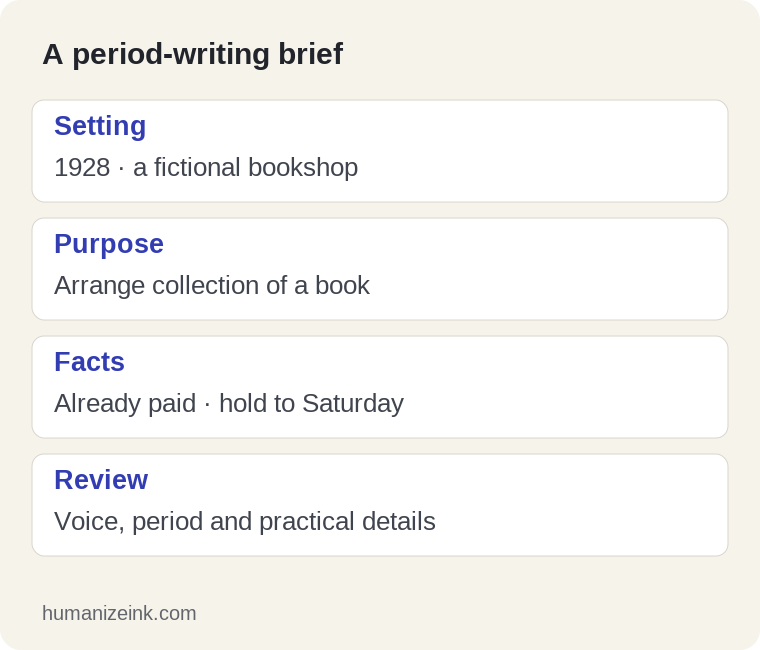
Use this original fictional brief:
- Setting: a small bookshop in 1928.
- Writer: the shopkeeper, replying to a fictional customer, Mr Lane.
- Purpose: say that a requested book has arrived and can be held until Saturday.
- Constraint: the customer has already paid; the letter asks only about collection.
Preserving the payment detail matters. A flowery request for payment would alter the situation, even if the sentence sounded appropriate to the period. Put that fact into the request and keep it in your review notes.
Try a focused period-writing prompt
Adapt this original prompt for an instruction-following writing model:
Write a short letter from a fictional bookshop in 1928 to Mr Lane.
Tell the customer that the requested book has arrived.
The customer has already paid. Ask when they will collect it.
The shop can hold the book until Saturday.
Use a courteous, formal 1920s shopkeeper register suitable for the setting.
Keep the letter under 90 words and preserve the practical details.
For a base model, a passage opening may be a better starting point than a conversational instruction. Begin with the form of text you want continued, then evaluate the continuation in the same way. The model label and interface help you choose which approach to try.
Keep the social setting specific
An older voice can be formal, intimate, commercial or comic. Identify the relationship rather than treating all historical writing as elaborate ceremony. A business note that gives a clear collection deadline has a different job from a character's private confession.
Review period details separately
Look for objects, services and expressions that belong to your chosen place and year. Use contemporary dictionaries, catalogs or archival material when a detail is important. A historically trained model is a source of generated language; a dated primary document supplies evidence about an actual practice.
Compare a manual editing example
These are original manual samples for the fictional brief. They illustrate a shift in register while keeping the arrival, prior payment, collection question and Saturday deadline. They are suitable material for a writing exercise rather than evidence that a particular bookshop used this exact wording.
 Original manual example
Change the register; keep the transaction
Modern draft
Hi, your book is here. You've already paid, so just let us know when you can pick it up. We'll keep it until Saturday.
Manual period-style revision
Dear Mr Lane, Your book has arrived and is ready for collection. As payment has already been received, please let us know when you intend to call. We shall be pleased to hold it until Saturday.
- Payment has already been received.
- Collection is requested, with a Saturday holding deadline.
humanizeink.com
Read historical output critically
Historical corpora can reflect the prejudices, assumptions and uneven representation of their period. Review the treatment of people as well as the vocabulary. Decide whether a viewpoint belongs to a character, whether the narrative explains it and how the passage serves your reader.
The project's research also concerns temporal knowledge and comparisons between training corpora. A lively response about a future event is an interesting passage to investigate, rather than an archival source. For factual exposition, verify the claim using material appropriate to the event and date.
Edit the English passage you choose
Select the version that fits your scene, then edit for clarity. If using Humanize Ink's English rewriting tool, keep the original alongside the result and review the changes. Preserve the words that establish the period, especially terms for objects or institutions.
For a passage where a period occupation creates confusion, the haberdasher guide shows how to explain a historical term through context. For repetition, compare your drafts in the word frequency counter. A repeated word may contribute to a character's voice, so use the count as a reading aid.
Finish with four checks
Read the practical facts, the period details, the speaker's relationship to the reader and the treatment of people. In the bookshop exercise, a successful revision retains prior payment and the collection deadline while establishing the tone you intended. Keep that checklist with the passage so later edits preserve the same purpose.
Frequently asked questions
What does 1930 mean in Talkie 1930?
The project uses historical English material from before 1931. The name points to that temporal training boundary, rather than a publication date for the software.
Which checkpoint follows writing instructions?
The official repository describes talkie-1930-13b-it as the instruction-tuned checkpoint. The base model is intended for text continuation, which is a different interaction pattern.
Where can I find the official project?
Start at talkie-lm.com and follow its links to chat, GitHub and model resources. Check the current access conditions on the publisher’s destination.
How do I ask for a period-style letter?
Give a year, a relationship, a purpose and practical facts. Set an appropriate length and register, then check objects and expressions against your chosen setting.
Is the bookshop letter an actual Talkie output?
The two passages are original manual writing samples. They illustrate how to review a period-style revision against a fictional brief.
What should I preserve when editing historical prose?
Keep important period terms, dates and practical facts. Read the speaker’s viewpoint and treatment of people critically, and use primary material for factual claims.