

Hullabaloo means a noisy commotion, an uproar or an excited fuss. It can describe people making a lot of noise, or all the talk around a disputed event. Cambridge Dictionary records it as a noun, and Dictionary.com also explains its use for public commentary.
Say it roughly huh-luh-buh-LOO, with the strongest stress at the end. The word has a lively, informal sound. It is useful in a story or conversational comment when the speaker’s reaction matters. This guide shows the common patterns and a practical way to turn a broad description into precise reporting.
Hear the difference between noise and fuss
A literal hullabaloo may involve raised voices, movement and competing demands for attention. In the original sentence “A hullabaloo broke out near the gate when the parade arrived,” the word gathers the crowd’s noise into one vivid impression.
A figurative use can describe commentary around an event: “There was a hullabaloo over the changed schedule.” The sentence may refer to conversations, messages and complaints rather than one audible disturbance. Read the surrounding text to see what form the reaction takes.
The word can also make a reaction sound excessive or amusing. “What a hullabaloo over a missing spoon” gives the speaker’s assessment of the fuss. A reader learns both that people reacted and that the speaker thinks the reaction deserves comment. Use that shade of attitude deliberately.
Pronounce and spell hullabaloo
Break the word into four spoken beats: huh · luh · buh · LOO. Cambridge gives /ˌhʌl.ə.bəˈluː/. The final syllable is stressed and has a long “oo” sound. Listen to a dictionary recording if you need the exact accent rather than a written approximation.
For spelling, notice the double l near the beginning and double o at the end: hullabaloo. Keeping the sound chunks together is more useful than inventing a meaning for each piece. The word works as one noun.
In ordinary prose, lowercase it unless it starts a sentence or appears within a proper title. If you are copying the name of a song, show or organization, preserve that title’s official spelling and capitalization. The everyday definition alone does not identify a particular named work.
Build useful sentence patterns
Start with a hullabaloo, a common way to refer to one episode of fuss. British learner entries often label the word as usually singular; some American dictionary treatments also allow the plural hullabaloos. For most everyday sentences, the singular phrase is the simplest choice.
Scroll to see all columns
| Pattern | Original example | What it emphasizes |
|---|---|---|
| A hullabaloo broke out | A hullabaloo broke out by the ticket desk. | The disturbance beginning |
| Make a hullabaloo about | They made a hullabaloo about the new seats. | A reaction to a topic |
| A hullabaloo over | The hullabaloo over the timetable lasted all morning. | The disputed issue |
| In the hullabaloo | In the hullabaloo, I missed the announcement. | The noisy situation |
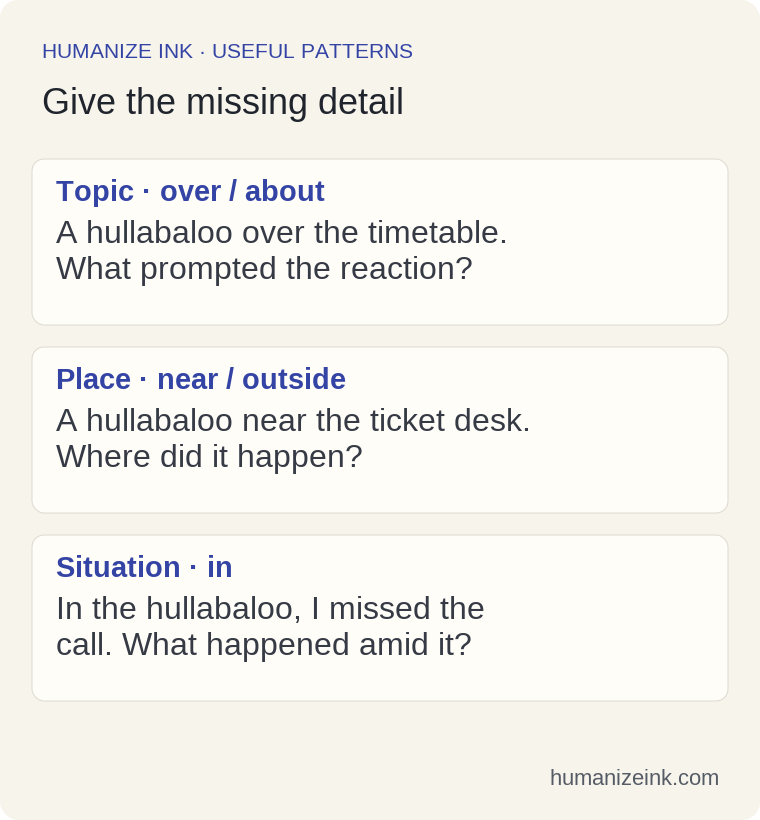
Use about or over for the topic
“The hullabaloo over the timetable” names the issue. “The hullabaloo near the ticket desk” names a location. You can combine them when both matter, but a short sentence usually needs only the detail the reader is looking for.
Name the concrete action when it matters
If you are reporting an incident, identify what people did. Were they cheering, arguing, sending complaints or asking questions? Hullabaloo gives an overall impression. A specific verb can preserve the facts that a reader needs to understand or respond to the event.
Compare hullabaloo, commotion, uproar and fuss
These words overlap, so choose them in context rather than treating them as interchangeable labels. Hullabaloo gives a lively, informal impression. Commotion is useful when the disturbance itself matters. Uproar can emphasize a strong public or collective reaction. Fuss often directs attention to the amount of concern or activity around something.
Compare these original choices: “A commotion began outside the room” leaves the writer’s attitude relatively open. “What a hullabaloo outside the room” gives the observer a more expressive voice. In a fictional scene, that voice may help establish a character. In a workplace record, the reader may prefer the actions and timings.
For another example of a word that carries the speaker’s judgment, read prate meaning. The useful question is the same: whose attitude should the sentence express, and does that attitude help this reader?
Revise a broad impression into a clear account
Original draft: “There was a huge hullabaloo over the room change.”
Manual revision for a meeting note: “After the meeting was moved to a different room, six attendees asked where to go, and the coordinator repeated the new location.”
This fictional teaching example supplies actions that an observer could record. The number six belongs to the invented scenario; use a count only when you know it. If the actual count is unknown, “Several attendees asked where to go” is a more suitable version.
A story might keep the expressive word instead: “In the hullabaloo over the room change, Sam followed the wrong group upstairs.” Here the noisy confusion explains Sam’s action. That makes the word do narrative work rather than simply rating everyone’s reaction.
 Original manual example
Choose a voice or an observable account
Expressive draft
There was a huge hullabaloo over the room change.
Manual meeting note
Six attendees asked where to go, and the coordinator repeated the new location.
- Use a count only when it is known.
- A story may keep the expressive word for narrative purpose.
humanizeink.com
Check the sentence in your own draft
Read the paragraph once for facts and once for voice. If the sentence must document what happened, preserve the location, action, sequence and any verified count. If it should communicate a character’s exasperation or amusement, hullabaloo may be the right word.
Use the English rewriting editor on a short, shareable excerpt and compare any change in attitude. For repeated wording across drafts, the word frequency counter can show written counts and shares. Those measurements can direct your attention; the surrounding sentence still determines the most useful choice.
Frequently asked questions
What does hullabaloo mean in simple English?
A noisy commotion or an excited fuss. It can describe audible noise or the talk and controversy around an event.
How do you pronounce hullabaloo?
Roughly huh-luh-buh-LOO, with the strongest stress on the last syllable. Cambridge provides audio for a more exact pronunciation.
Is hullabaloo a noun or a verb?
It is a noun in the usage covered here. Use phrases such as a hullabaloo broke out or they made a hullabaloo about the change.
Can a hullabaloo happen online?
Yes. The word can refer to public commentary or controversy, even when the reactions are written rather than literally noisy.
Is hullabaloo rude?
It is informal and expressive. Depending on context, it may make a reaction sound excessive or amusing; choose more concrete wording when a neutral account is needed.
Should I use a hullabaloo or hullabaloos?
A hullabaloo is the usual everyday pattern. Some American dictionary treatments allow the plural, but the singular is sufficient for one episode of fuss.