


The most accurate AI humanizer is the one that helps you improve readability while preserving what your original actually says. To choose one, test the same passage in each tool and compare the result against the original: names, numbers, dates, quotations, uncertainty and exclusions all need individual checks. A fluent paragraph is not evidence that its facts are unchanged.
We do not have a current, controlled head-to-head accuracy test for these products, so this guide does not name a universal winner or assign invented scores. Instead, it gives you a repeatable way to find an option suitable for your own work.
What does accuracy mean in a rewrite?
For a rewrite, accuracy has several parts. Fact preservation means a number or named entity has not changed. Logical preservation means a condition, negation or exception still applies. Degree of certainty means “may” has not become “will.” Quotation integrity means words presented as a direct quote remain exact and citation markers stay attached to the right claim.
Fluency matters too, but it is a separate question. A result can read naturally and still turn an estimate into an agreed price. A result can preserve every detail but be awkward to read. Assess both dimensions.
Build a short, fair test
Use an original paragraph that you have permission to share. Include a few details that matter to you, rather than stuffing a paragraph with random traps. This example is created for explanation:
Northwind plans to review the proposal on 18 June. The estimate is $240, excluding shipping. Testing may change the result. A reviewer wrote, “Check the final figures.” [2]
Before you run anything, make a checklist: Northwind; 18 June; estimate rather than final price; $240; shipping excluded; testing may change the result; the exact quotation; and marker [2]. These are not interchangeable. “Shipping excluded” does not establish that shipping was billed separately.
- Submit the same input to each tool, subject to its terms and limits. Use non-sensitive text.
- Choose comparable options where possible; document the setting when they are not equivalent.
- Compare each output to the source using the checklist. Mark a detail as preserved, changed or unclear, and keep the actual output for your own review.
- Read for grammar, tone and repetition separately. Do not award a high accuracy result just because the prose is polished.
- Repeat with another passage if the decision matters. One short sample cannot establish a universal ranking.
When publishing a comparison, record the date, exact versions or settings, inputs, outputs and limitations so readers can inspect the evidence.
A useful review sheet
Scroll to see all columns
| Check | Question | Example of a risky change |
|---|---|---|
| Number | Is every quantity the same? | $240 becomes $420. |
| Status | Is a proposal or estimate still provisional? | “Plans to review” becomes “reviewed.” |
| Scope | Does each condition, negation or exception still apply? | “Excluding shipping” becomes “shipping included.” |
| Certainty | Is the same level of certainty preserved? | “May change” becomes “will change.” |
| Quote | Are direct words and their attribution exact? | Rewording inside quotation marks. |
| Reference | Does the citation marker still support the same claim? | Moving [2] to another sentence. |
A side-by-side display or local difference view can make changes easier to find, but it does not verify facts automatically.
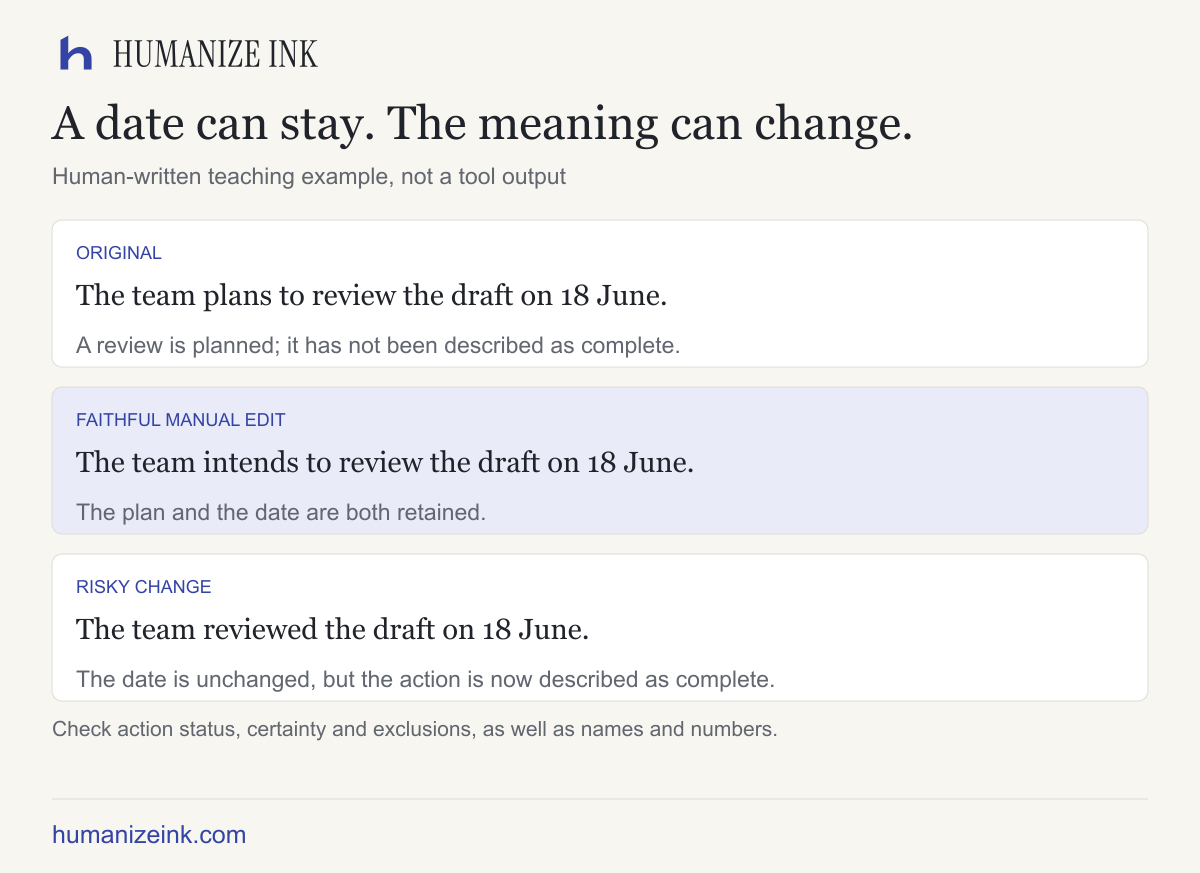
What a historical check actually shows
In an original Humanize Ink QA sample recorded on October 2, 2026, the input was:
On October 2, 2026, Northstar Labs tested the Atlas prototype in Bristol. The team has not launched it publicly.
The archived output was:
Northstar Labs tested the Atlas prototype on October 2, 2026, in Bristol. The team has not launched it publicly.
In this archived sample, the date, names, location and distinction between testing and public launch stayed intact. The sentence order changed, while “has not launched it publicly” remained. The same QA example is shown in our editing workflow.
This is a historical original test, not a fresh evaluation of today's service or a benchmark against another vendor. It demonstrates what to inspect. It cannot tell you which product is universally the most accurate.
Compare review controls, then compare actual text
Scroll to see all columns
| Product | Published review aid | What still needs your judgment |
|---|---|---|
| Clever AI Humanizer | Show changes alongside rewriting; Normal and Clear & Structured styles | Whether a changed phrase still asserts the same thing. |
| Grammarly | Basic humanization, with additional style and voice features through an account | Whether the selected voice preserves the original's detail and certainty. |
| Humanize Ink | Comparison view and locally editable final text | Facts, quotes, citations and the suitability of each edit. |
These controls make review more convenient; their presence is not proof of accuracy. The product descriptions come from the linked pages checked on November 9, 2026. We operate Humanize Ink. This table compares review affordances, not newly measured quality results.
Select a tool for the type of writing
For a casual email, readability and tone may be most important, but check dates and promises. For a product specification, prioritize quantities, units, compatibility and exclusions. For academic writing, keep quotations, citations and uncertainty intact, and follow your institution's rules on AI assistance. For a contract or medical document, use the appropriate qualified reviewer; a writing tool cannot validate the underlying advice.
Also check the service's current input limit, availability and data handling. “Free” does not necessarily mean private or unlimited. Avoid sending sensitive text to a provider unless you have permission and understand its current terms.
Humanize Ink accepts an existing English draft and provides rewrite options, a comparison view and local result editing. Its rewriting request is processed by a third party, as explained in its privacy policy. You remain responsible for checking the result.
What about AI detector scores?
A detector score does not check whether a date, number or attribution is correct. Do not use it as a proxy for factual accuracy, and do not rely on a humanizer to guarantee a particular detector outcome. Check the text and its sources instead.
For the most useful comparison, start with one non-sensitive paragraph, document the actual settings, and keep the original beside each output. Choose the option that preserves the important details and supports the editorial control you need—not a tool based on a score that does not measure your task.
Sources and next steps
Clever's product page and Grammarly's humanizer page support the interface descriptions above. Humanize Ink's historical date example was recorded on October 2, 2026 and is original QA, not customer text. For input sizes and free-access conditions, see the free-humanizer comparison.